

Last updated: October 2, 2026
Published October 2, 2026 · Updated October 2, 2026
Weak batteries, DEFA 35A workshop charger planning, 24 vehicle overnight fleet, Vaughan: yes, a few weak batteries can skew the whole plan. A 12V battery resting near 12.0 volts needs roughly three times the recharge of one resting at 12.4 volts, and most of that extra time is spent in the absorption stage, where a bigger charger cannot hurry the battery along.
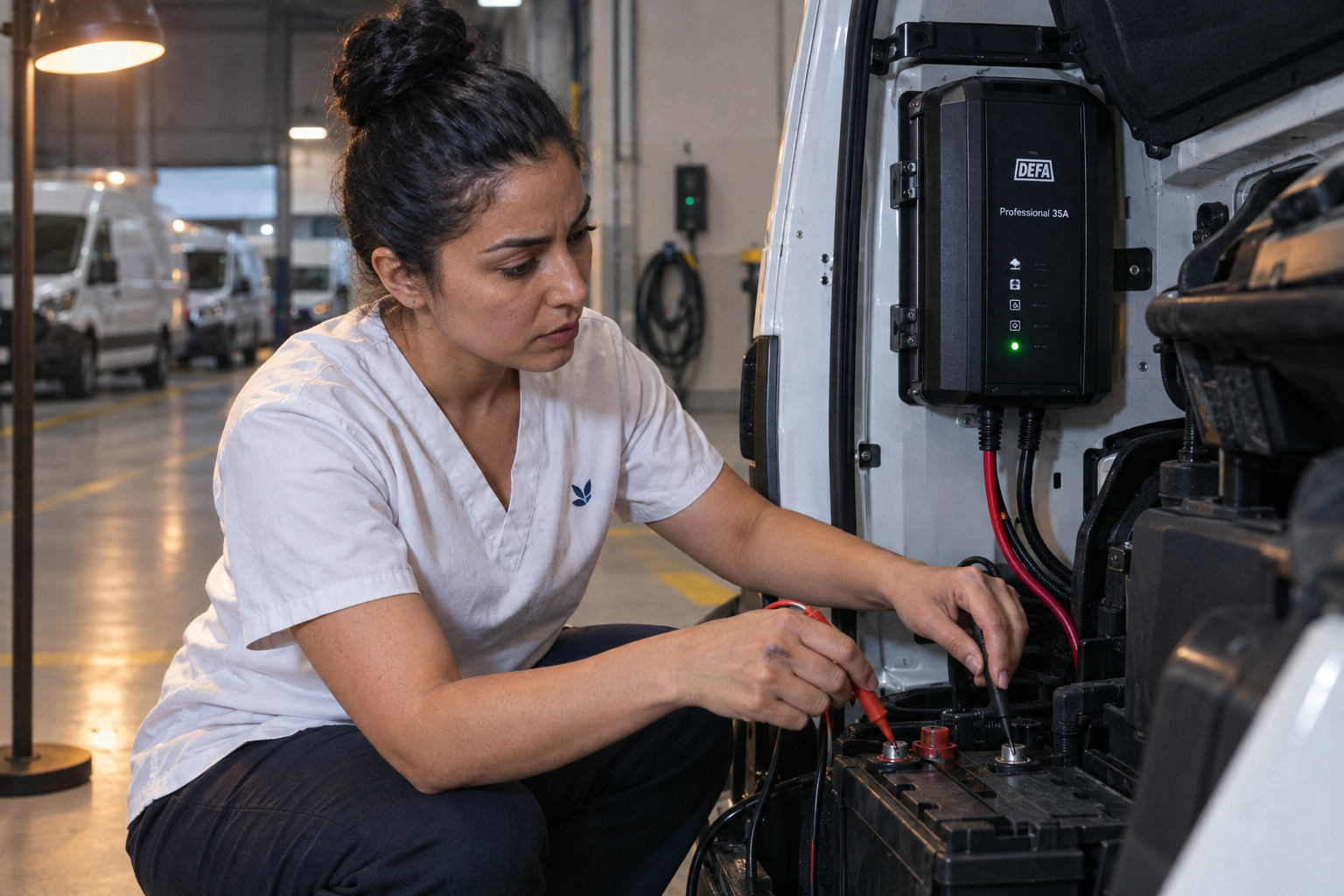
The question usually lands in late fall, when the first hard frost glazes the windshields and two vans crank slow at dawn. It matters because the overnight charge is the only window a fleet gets to recover, and a plan built on averages quietly fails on exactly the vehicles that need it most.
If you're a fleet supervisor in Vaughan with 24 vehicles parked overnight and a DEFA Professional 35A Workshop Charger on the bay wall, this walkthrough is for you. It is not for someone choosing a maintainer for one weekend car.
- A 12V flooded battery resting at about 12.0 volts is roughly 25% charged and needs about three times the amp-hours of one resting at 12.4 volts (about 75%).
- The DEFA Professional 35A Workshop Charger shortens the bulk stage, but absorption time is limited by the battery itself, so deeply discharged batteries still tie up hours of the overnight window.
- Testing all 24 vehicles before the overnight charge and sorting them into green, yellow and red tiers is what keeps a fleet charging plan honest.
- A low-output consumer trickle charger often cannot keep up with parasitic drain from telematics, alarms and infotainment, one of the most common mistakes ESN Tools sees in the field.
- Alert Stamping cord reels such as the 8645TFI (45ft, 20A) carry AC power to chargers; they never charge or maintain a battery themselves.
- The DEWALT DXAEPS14-Type2 (2000 peak amps, 500W AC inverter, 120 PSI compressor) is a morning safety net, not a substitute for overnight recovery.
- Why one deeply discharged battery can eat a disproportionate share of a 35A charger's night.
- The seven-step triage process we walk fleet teams through before the first charger gets plugged in.
- Which DEFA, DEWALT, BLACK+DECKER and Alert Stamping tools fit each tier, and what each one is not for.
- The field mistakes (floor-coiled cords, trickle chargers, peak-only inverter sizing) that quietly break overnight plans.
Why Weak Batteries Skew DEFA 35A Workshop Charger Planning for a 24 Vehicle Overnight Fleet in Vaughan
Weak batteries skew DEFA 35A workshop charger planning because a multi-stage charger does not spend its time evenly. The bulk stage, where the full 35 amps can flow, goes quickly. The absorption stage, where current tapers as the battery fills, is set by the battery's chemistry and condition, not by the charger's rating.
Here is the planning math we use, with a 70 amp-hour battery as an example. A battery resting at 12.4 volts (about 75% charged) is missing roughly 17.5 amp-hours. A battery resting at 12.0 volts (about 25% charged) is missing roughly 52.5 amp-hours, exactly three times as much, before you add the losses every charge cycle carries.
Amps buy you bulk time. They do not buy absorption time. That single idea is what most overnight fleet charging plans in the GTA miss.
The averages trap
Say the yard's overnight window runs 12 hours, from end of shift to first dispatch. If one 35A unit had to serve all 24 vehicles in rotation, each vehicle would average 30 minutes of charger time. That is plenty for a healthy battery that needs a top-up and nowhere near enough for a battery that limped in at 12.0 volts.
Averages lie. A plan that treats all 24 vehicles as identical will look fine on paper and fail on the three or four trucks that actually needed help.
Why Vaughan winters make it worse
Vaughan winter nights regularly drop well below freezing, as Environment and Climate Change Canada's historical climate records for the area show. A cold battery delivers less cranking power and accepts charge more slowly, so the same weak battery that recovered in October can still be short in January.
A deeply discharged battery can also freeze in hard cold. Never charge a frozen battery. Bring it indoors and let it thaw first.
The Process, Step by Step
The overnight fleet battery triage process below is what we walk supervisors through when they ask how to plan charger time for 24 vehicles. It takes one careful evening to set up. After that, it becomes a routine.
Before any charger gets plugged in, list every vehicle, its battery type (flooded, AGM, or EFB in start-stop models) and anything that draws power while parked, like telematics boxes, dash cams and alarm modules. Chemistry matters because the charge profile has to match the battery. Parasitic draw tells you which vehicles drain fastest between shifts.
A battery fresh off a route carries surface charge that makes it look healthier than it is, so take readings after the vehicle has sat for a while. In a dark January yard, a BLACK+DECKER SLV2B 750-lumen rechargeable flashlight keeps the terminals visible without stringing a work light cord across the lot.
Voltage alone cannot tell a discharged battery from a sulfated one, because both can read low at rest. A battery that sags sharply under load or shows a weak conductance reading goes straight to the red tier. No amount of charger time fixes a failed cell.
DEFA Professional 35A Workshop Charger time goes to the yellow tier first, early in the night, because those batteries can genuinely recover before dispatch. Green-tier vehicles get a maintainer such as the DEWALT 12V 4 Amp waterproof charger/maintainer. Red-tier batteries come out of the plan entirely.
DEFA Professional Workshop Chargers are hard-wired, so their circuits should already be installed and labeled by a licensed electrical contractor. For portable units, route power with a retractable reel like the Alert Stamping 8645TFI (45ft, 12/3, 20A) instead of coiling cords on the floor, which creates trip hazards and wears insulation faster.
Batteries that need closer attention come out of the vehicle and go on a BLACK+DECKER BC25BD 25 Amp 12V bench charger in a warm, ventilated room. If you catch the rotten-egg smell of a gassing battery, stop and investigate before anything else.
A charged DEWALT DXAEPS14-Type2 (2000 peak amps, 120 PSI digital compressor, USB-A/C) sits by the dispatch door for the vehicle that slipped through. Each yellow-tier battery gets a resting voltage logged, and any battery that needs a second recovery in the same week moves to red.
The triage chart we start from
The resting voltage chart below uses widely published approximate values for a 12V flooded lead-acid battery near room temperature. AGM batteries read slightly higher at the same state of charge, so adjust accordingly.
| Resting voltage (12V flooded) | Approx. state of charge | Tier | Overnight plan |
|---|---|---|---|
| 12.6V or higher | About 100% | Green | Maintainer only, e.g. DEWALT 12V 4 Amp |
| 12.4V | About 75% | Green | Maintainer or a short top-up late in the night |
| 12.2V | About 50% | Yellow | Priority DEFA 35A time, first in the rotation |
| 12.0V | About 25% | Yellow or red | Load test first; full cycle only if it passes |
| 11.9V or lower | Deeply discharged | Red | Check for freezing, bench recovery or replace |
Tools We Use
The tools in a 24 vehicle overnight charging setup each have one job, and most planning errors come from asking a tool to do a job it was never built for. Here is how each ESN Tools catalog item fits the tiers.
| Tool | Job in the plan | Not built for |
|---|---|---|
| DEFA Professional 35A Workshop Charger | Hard-wired multi-stage charging for yellow-tier recovery in the service bay | Reviving a battery with a failed cell |
| DEWALT 12V 4 Amp waterproof charger/maintainer | Holding green-tier batteries steady overnight | Recovering a deeply discharged battery by morning |
| BLACK+DECKER BC25BD | 25 Amp 12V bench charging for batteries pulled from vehicles | 6V batteries (it is a 12V charger) |
| DEWALT DXAEPS14-Type2 | 2000 peak amp jump starts, 500W AC inverter, 120 PSI digital compressor, USB-A/C | Replacing an overnight charging plan |
| Alert Stamping 8645TFI | 45ft, 12/3, 20A retractable reel carrying AC power to portable chargers | Charging or maintaining batteries (it is a cord reel) |
For shorter runs, the Alert Stamping 5020TF-4C (20ft, 12/3, 15A, four outlets) handles a cluster of portable chargers at a bench, provided their combined draw stays within the reel's rating. You can browse the full range of DEFA workshop chargers and Alert Stamping retractable cord reels on the ESN Tools site.
Where It Gets Tricky
Overnight fleet battery charging goes wrong in predictable places, and almost none of them involve the charger itself. The failures we see most come from mixed equipment, sloppy power routing and tools sized by the wrong number.
Trickle chargers versus parasitic drain
A low-output consumer trickle charger is the most common shortcut on display lots and fleet yards. In our experience, it often lacks the amperage to overcome the parasitic drain from infotainment, alarm modules and telematics, so the battery slowly loses ground even while it is connected. The charger light looks reassuring. The battery keeps sliding.
Mixed chemistries and mixed voltages
Start-stop vehicles with AGM or EFB batteries need the right charge profile, and a fleet that mixes them with flooded batteries needs that noted on the roster. We also see yards mixing 6V and 12V chargers on the same power-supply circuit, which invites a tired technician to clip the wrong charger onto the wrong battery at the end of a long shift. Separate circuits and clear labels prevent that mistake entirely.
Cords, inverters and wash bay lighting
Extension cords coiled on a wet bay floor create trip hazards and wear insulation faster, which is why a retractable reel like the Alert Stamping 8645TFI earns its spot on the wall. Inverters get sized wrong too: buyers look only at peak load and ignore continuous-rating headroom. Treat the 500W AC inverter on the DEWALT DXAEPS14-Type2 as a ceiling, and leave real margin below it for anything you run for long.
Wash bays have their own trap. Lighting that is not IP-rated for wet environments tends to fail within months, leaving technicians reading battery labels by phone light at the coldest hour of the morning.
Jump starters that look strong on the box
Generic jump starters without a standards-based (ANSI) peak amp rating are a recurring field failure, and they tend to give up on cold-cranking diesel engines first. A fleet with diesel pickups should match the jump starter's published rating to the engine and the manufacturer's guidance, not to a big number printed on the packaging. Training is what ties all of this together: a tool is only as good as the person who knows when not to use it.
What This Means for You as the Customer
For a fleet supervisor in Vaughan, Brampton or Mississauga planning DEFA 35A workshop charger coverage, the practical takeaway is simple: size the plan to your weakest batteries, not your average ones. Ask how many yellow-tier batteries your yard typically produces on a cold week, because that number drives how much 35A charger time you actually need.
Expect a good conversation about chargers to start with your batteries. That is backwards from how most people shop. It is also the right order.
- How many of my 24 vehicles use AGM or EFB batteries, and does that change which DEFA Professional Workshop Charger fits best (30A, 35A, 50A or 125A)?
- Do my green-tier vehicles need a DEWALT 12V 4 Amp maintainer, or is a DEWALT DXAEC2 (2 Amp) enough for their parasitic draw?
- Where should hard-wired DEFA units sit relative to my parking layout, and what reel length (20ft or 45ft) covers the gaps?
- Which jump starter fits my heaviest cold-start vehicle, and how should it be stored and kept charged?
ESN Tools does not publish prices, so pricing for any configuration comes through a direct conversation. You can review battery chargers and maintainers and DEWALT jump starters first, then reach out with your fleet roster in hand.
Our Take After Years of Keeping Dealership and Fleet Batteries Charged
Our view at ESN Tools is that fleet teams overweight charger amperage and underweight battery testing. A bigger charger feels like insurance. In practice, the hour spent testing all 24 vehicles before the night begins does more for weak batteries DEFA 35A workshop charger planning than any upgrade in amps.
What surprises most supervisors is how often the problem is one or two dying batteries rather than an undersized charger. Pull those out of the rotation, and the rest of a 24 vehicle overnight fleet in Vaughan usually settles into a calm, repeatable routine. Keep charging them, and they quietly steal the night.
If a friend ran a yard, here's what we'd tell them. Test first, tier second, buy third. And hang the cords on a reel.
FAQ: Weak Batteries and Overnight Fleet Charging
How many vehicles can one DEFA Professional 35A Workshop Charger cover overnight?
One DEFA Professional 35A Workshop Charger can cover very different numbers of vehicles depending on battery condition, because the 35A rating speeds up the bulk stage while absorption time is set by the battery itself. In a 24 vehicle fleet, a handful of batteries resting near 12.0 volts can consume a disproportionate share of the overnight window. Test first, then size the plan, and contact ESN Tools to talk through unit count for your yard.
Should fleet batteries be tested before or after the overnight charge?
Fleet batteries should be tested both before and after the overnight charge. The evening test sorts all 24 vehicles into green, yellow and red tiers, while the morning reading, taken after the surface charge settles, shows which batteries actually held their charge. A battery that comes off the charger looking full but drops back toward 12.2 volts by the next evening is a replacement candidate, not a charging problem.
Can an Alert Stamping cord reel charge or maintain a fleet battery?
An Alert Stamping cord reel cannot charge or maintain a battery, because models like the 8645TFI (45ft, 20A) and 5020TF-4C (20ft, 15A, 4 outlets) are retractable extension cord reels that deliver AC power. Their job is to carry power from the wall to a portable charger, such as the BLACK+DECKER BC25BD, without leaving cords coiled on the bay floor. Always confirm the combined draw of anything plugged in stays within the reel's rating.
Is a jump starter a substitute for overnight fleet charging?
A jump starter is not a substitute for overnight fleet charging; the DEWALT DXAEPS14-Type2, with 2000 peak amps, a 500W AC inverter and a 120 PSI digital compressor, is a morning safety net for the vehicle that slipped through. Jumping the same weak battery day after day hides a failing unit and puts extra recharge work on the alternator. If a vehicle needs a jump twice in one week, pull the battery and test it.
Sources
- Ontario requirements for licensed electrical contractors and notification of hard-wired electrical work: Electrical Safety Authority (Ontario)
- Winter temperature records for Vaughan and the Greater Toronto Area: Environment and Climate Change Canada, Historical Climate Data
- DEFA professional charger product information: DEFA
- DEWALT, BLACK+DECKER and Alert Stamping model specifications referenced in this article: ESN Tools product catalog
🎧 Listen to article
- BLACK+DECKER BC25BD vs DEFA Professional 35A Workshop Charger: Which 12V Bench Charger Makes Sense for a GTA S
- A Service Manager Asked: "Can a DEFA Professional Showroom Charger Stay Connected to a Display Vehicle All Mon
- An Ottawa Fleet Manager Asked: "Does the DEFA 125A Workshop Charger Handle Multiple Vehicles Overnight Without
- DEFA Professional Workshop Charger 35A vs DEFA Professional Workshop Charger 30A: Which Output Fits a Moderate
- How an Edmonton Multi-Location Dealership Standardized Battery Maintenance Across 3 Service Bays With the DEFA