

Last updated: November 8, 2026
Published November 8, 2026 · Updated November 8, 2026
 Listen to this articleAudio version
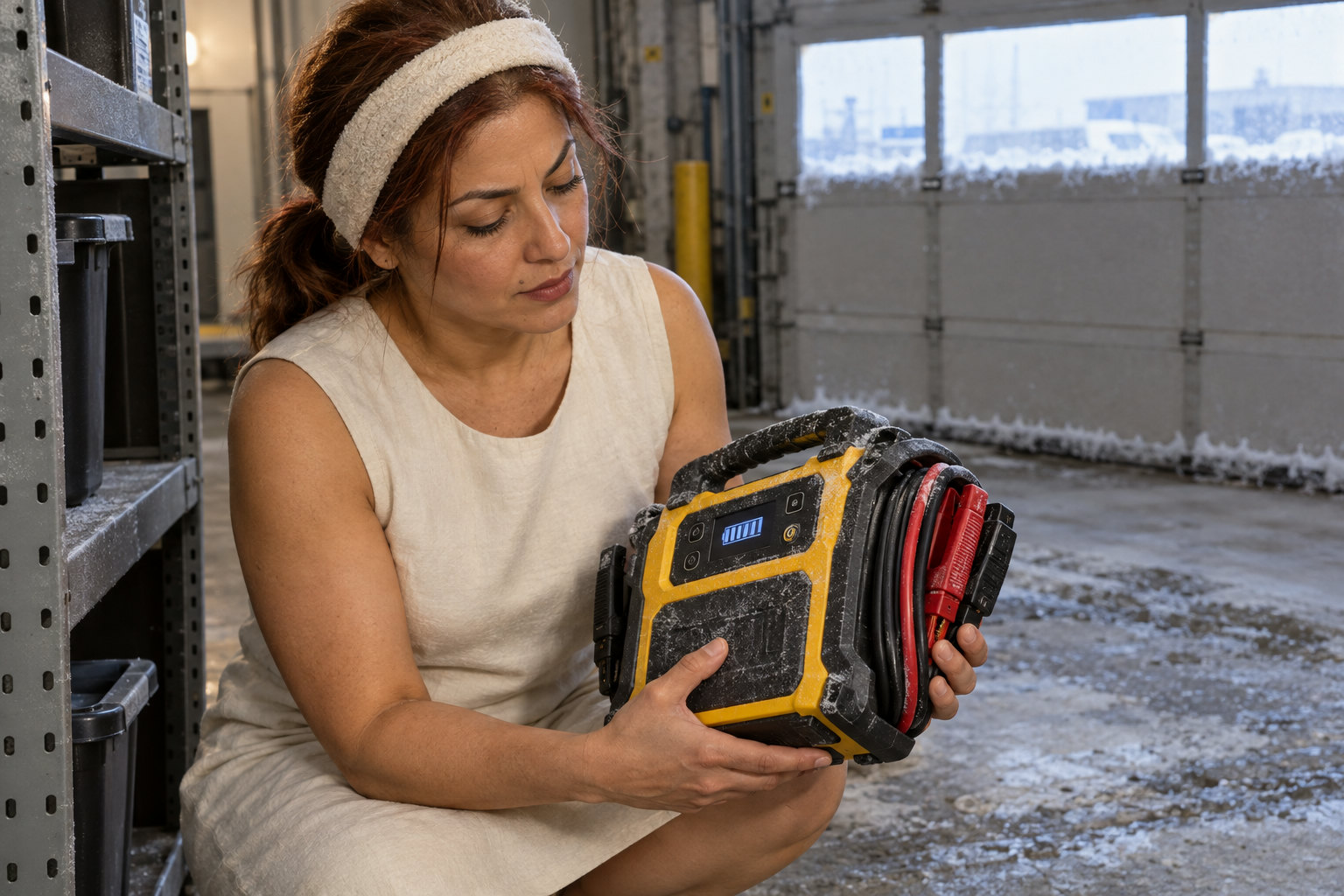
Winnipeg unheated bay storage for DEWALT DXAEJ14-Type3 works when the unit sits fully charged on a shelf off the concrete and warms to room temperature before every recharge. January in this city averages roughly -16°C (about 3°F), so a jump starter left in an unheated bay is effectively stored outdoors. That cold weakens the starter and the engine it is trying to crank, both at once.
If you're a service manager or lot porter whose jump starter lives in a back bay with no heat, this guide is for you. It covers what to check before a winter jump: the charge, the cables, the compressor hose and the dead battery itself. It is not meant for someone who keeps the unit in a heated cab or office year-round.
- The DEWALT DXAEJ14-Type3 is a jump starter and portable power station with a 120 PSI digital compressor and USB power, so a cold bay affects its battery, its hose and its cables.
- A cold-soaked jump starter delivers less usable power at the clamps, and a cold engine needs more power to turn over, so the two losses stack on a January morning.
- Recharging should happen after the unit has warmed indoors, on the temperature range DEWALT lists in the manual, never straight off a sub-zero shelf.
- A standard block heater warms the engine coolant or oil, not the battery, so a plugged-in vehicle can still need a boost.
- Never connect any jump starter to a vehicle battery with a bulged or frozen case; a discharged lead-acid battery can freeze, and a frozen one can rupture.
- The average January daily temperature is roughly -16°C, according to Environment and Climate Change Canada's 1981-2010 climate normals.
- Daylight near the December solstice runs to only about eight hours, so many morning jumps happen in the dark.
- The city sits on the flat floor of the Red River Valley, where little breaks the prairie wind that pours in whenever a bay door opens.
- Plug-in outlets for engine block heaters are a standard fixture in parking lots and driveways.
- Daytime highs below freezing are normal from December through February, so an unheated bay can stay sub-zero for weeks at a stretch.
What Makes Winnipeg Different for Unheated Bay Storage of the DEWALT DXAEJ14-Type3
Unheated bay storage for a DEWALT DXAEJ14-Type3 is a different job on the Prairies than in a milder coastal city. A sub-zero bay holds its cold for weeks, not overnight. The unit never gets a mild afternoon to recover between cold snaps.
The building matters too. Most unheated bays are a concrete slab, a steel or block shell, and an overhead door. Concrete is a large heat sink: once it reaches the outdoor temperature, it pulls warmth out of anything set directly on it, including a jump starter case and the battery inside.
Wind, doors and the open-bay effect
Flat Red River Valley terrain gives prairie wind a long, clear run. Each time a bay door opens to pull a vehicle in, the inside air is swapped for outside air within minutes. An unheated bay therefore tracks the outdoor temperature closely, with only a few degrees of shelter from the wall and roof.
That is why the shelf location matters. A jump starter on a shelf against an interior wall, away from the door path, sees less direct cold air than one parked on the floor next to the overhead door.
Why block heaters don't remove the need for a boost
Block heater outlets are everywhere here, and they help a lot. A standard block heater warms engine coolant or oil, which thins the oil and makes cranking easier. It does not warm the battery. A vehicle that sat plugged in overnight can still have a cold, weak battery, especially if short trips never let the alternator top it up.
Dealership lots and used-vehicle inventory add another layer. Trade-ins and units waiting on parts often sit unplugged for days. Infotainment modules and alarms draw small currents the whole time, so the battery drains while the cold cuts what it can deliver.
Short days, dark lots
With about eight hours of daylight near the December solstice, the first jumps of a shift usually happen before sunrise. Reading a polarity mark on a dirty battery post by phone light is how clamps end up on the wrong terminal. A dedicated light, such as the BLACK+DECKER SLV2B flashlight, belongs in the same spot as the jump starter.
The Problems Jump Starters Run Into in a Cold Back Bay
A DEWALT DXAEJ14-Type3 stored in an unheated bay faces four predictable problems: low charge, cold charging, stiff hardware and moisture. None of these is a defect in the unit. Each one comes from how and where it is kept.
1. Stored half-charged, on the floor
Every battery self-discharges during storage, and a jump starter used for one boost and put back without recharging starts the next week already short. Cold then reduces how much of the remaining charge reaches the clamps. A unit that showed a healthy reading in October can come up short on the first hard morning in January.
The fix is simple. Recharge after every jump, and top it up during storage on the schedule DEWALT's manual sets for the unit.
2. Recharged while still cold-soaked
Battery makers generally warn against charging a battery that is far below freezing, and the DXAEJ14-Type3 manual lists the charging temperature range to follow. Plugging the unit in on a sub-zero shelf, straight after a jump, can mean an incomplete charge at best. The better habit is to bring it indoors, let it reach room temperature, then charge it.
3. Stiff cables, clamp springs and compressor hose
Cable insulation and rubber hose stiffen in deep cold. Forcing a frozen cable around a radiator support, or bending the compressor hose sharply onto a valve stem, is how small cracks start. Clamp jaws can also hold ice or road salt residue that keeps them from biting a terminal cleanly.
The 120 PSI digital compressor on the DXAEJ14-Type3 is useful here, since tire pressure falls as temperature drops; a common rule of thumb is about 1 PSI for every 10°F of cooling. Fill to the pressure on the driver's door placard, measured cold, and let the hose warm a little in the cab before you thread it on.
4. Condensation and meltwater
Carrying a frozen unit into a warm, humid office or vehicle cab lets moisture condense on the case, the display and the USB ports. Snow that melts off tires and boots also pools on bay floors. Keeping the unit closed in a carrying case or bag while it warms, and off the floor entirely, limits both.
Two buying and setup mistakes to avoid
A common mistake is buying a generic jump starter with no clearly stated rating standard for its peak amps, then finding it can't turn over a cold-soaked diesel. For shops that jump trucks often, a unit with a documented rating, such as the DEWALT DXAEPS14-Type2 at 2000 peak amps, is the safer match.
Another common mistake is coiling extension cords on the bay floor to reach a charging shelf. Loose coils create trip hazards in a dark bay, sit in meltwater and wear their insulation faster. A wall-mounted retractable reel keeps the cord off the floor and stored the same way every time.
How to Set Up Cold-Bay Storage and a Pre-Jump Check
Good unheated bay storage for DEWALT DXAEJ14-Type3 units starts with three things: a fixed shelf, a warm place to charge and a written pre-jump check. The shelf should be on an interior wall, at waist height, away from the overhead door path. The charging spot should be indoors, in a heated office, parts room or tech area.
For a dealership service manager with a full lot of cold-soaked trade-ins, the routine matters more than the hardware. Every porter should grab the unit from the same place, do the same checks and return it to the same charging spot. For more on recharge timing during busy shifts, see this guide to recharging the DXAEJ14-Type3 between calls.
The pre-jump checklist
| Check | Why it matters in an unheated bay | What to do |
|---|---|---|
| Charge display on the DXAEJ14-Type3 | Self-discharge and cold both cut usable power | Do not attempt a hard cold start on a low reading; swap to a charged unit |
| Cables and clamp jaws | Stiff insulation cracks; ice and salt stop a clean bite | Look for cracks, wipe the jaws, open and close each clamp before use |
| Vehicle battery case | A discharged lead-acid battery can freeze | Never jump a bulged, cracked or visibly frozen battery; let it thaw and test it |
| System voltage | Some trucks and equipment run different systems | Confirm it is a 12V system that the unit is designed for |
| Compressor hose | Cold rubber is brittle | Warm it briefly in the cab; avoid sharp bends at the valve stem |
| Lighting | Roughly eight hours of December daylight | Use a flashlight like the BLACK+DECKER SLV2B to read polarity marks |
A cold-morning jump sequence
Check the charge display first. If it reads low, take a second charged unit rather than gambling on a cold engine.
Look for a bulged, cracked or frozen case. If you see any of these, stop; a frozen battery should thaw before anyone connects to it.
Red clamp to the positive terminal, black clamp to the ground point DEWALT specifies, with the unit switched off while you connect.
Keep each crank attempt and the rest between attempts within the limits printed in the manual. Long cranks on a cold engine heat the starter motor and drain the unit.
Remove the clamps in reverse order, carry the unit indoors in its case, let it reach room temperature, then recharge it fully before it goes back on the shelf.
Matching the tool to the job
A jump starter, a battery charger and a cord reel do different jobs, and a cold bay usually needs more than one of them. The table below matches each ESN Tools product to the job where it genuinely fits best.
| Product | What it is | Best fit |
|---|---|---|
| DEWALT DXAEJ14-Type3 | Jump starter / power station, 120 PSI digital compressor, USB power | All-round lot and roadside jumps plus tire top-ups |
| DEWALT DXAEPS14-Type2 | 2000 peak amp jump starter / power station, 500W AC inverter, 120 PSI compressor, USB-A/C | Shops jumping larger engines and needing AC power on the spot |
| DEFA Professional Workshop Chargers | Hard-wired multi-stage automotive chargers | Service bays recovering and supporting vehicle batteries during work |
| DEWALT DXAEC2 / DEWALT 12V 4 Amp waterproof charger | Battery charger and maintainers | Keeping stored or slow-moving vehicles topped up |
| BLACK+DECKER BC25BD | 25 Amp 12V bench charger | Charging a battery pulled from a vehicle on the bench |
| Alert Stamping 8645TFI | 45ft 20A retractable extension cord reel | Bringing AC power to a charging shelf without floor coils (it does not charge batteries) |
| Alert Stamping 8150MM / 920LSM | Retractable cord reels with LED work light | Dark bays where power and light are needed at the same spot |
The cord reels deliver and retract AC power only; they never charge or maintain a battery. Their value in a cold bay is keeping the cord off a wet, frozen floor. For cold-weather details on the 20A reel, read this piece on the Alert Stamping 8645TFI in an unheated bay.
If you're weighing the two DEWALT units for winter roadside work, the DXAEPS14 vs DXAEJ14 comparison lays out the trade-offs. The DEWALT DXAEJ14 product page lists the unit's current details.
Our view
In our opinion, buyers tend to overweigh the peak amp number printed on the box and underweigh the state of the unit on the morning it is needed. A jump starter's rating describes a fresh, fully charged unit at a mild temperature. A half-charged unit pulled off a frozen floor is not that unit.
What actually matters for unheated bay storage for DEWALT DXAEJ14-Type3 units is routine: charge indoors, store off the concrete, inspect before each jump. If a shop regularly boosts larger diesel engines, we think the DXAEPS14-Type2, with its documented 2000 peak amps and 500W inverter, is the better primary unit, with the DXAEJ14-Type3 as the lighter all-round backup.
We also think shops lean on jump starters for a job a maintainer does better. A vehicle that sits for days should be on a DEWALT DXAEC2 or 12V 4 Amp maintainer, or a DEFA workshop charger in the service bay, so it never needs the boost in the first place.
- DEWALT DXAEPS14-Type2 vs DEWALT DXAEJ14-Type3: Which Jump Starter Power Station Suits a Canadian Winter Roadside Call
- A Montreal Dealership Parts Manager Asked: "Can the DEWALT DXAEJ14-Type3 Jump Starter's USB Output Charge Diagnostic Tablets Between Calls?", Here's What to Know
- DEWALT DXAEJ14-Type3 vs BLACK+DECKER BC25BD: Portable Jump Starter vs Bench Charger for a Canadian Mobile Mechanic
- DXAEJ14-Type3 1400A Jump Starter With AC Outlets: Mobile Tech Buyer Guide
- DEFA Professional Workshop Charger 50A vs DEWALT DXAEPS14-Type2 Power Station: Fixed Bay Charger vs Portable Jump Starter for a Canadian Fleet Yard
Frequently Asked Questions
Can I leave a DEWALT DXAEJ14-Type3 in an unheated garage all winter?
Leaving a DEWALT DXAEJ14-Type3 in an unheated garage is workable if it is stored fully charged, on a shelf off the concrete, and recharged on the schedule in DEWALT's manual. Expect less usable power on a -16°C morning than on a mild one. Always bring it indoors to warm before recharging.
Should I charge a jump starter while it is still frozen?
Charging a frozen jump starter is not recommended; battery makers generally warn against charging far below freezing, and the DXAEJ14-Type3 manual gives the allowed charging temperature range. Carry it indoors in its case, let it reach room temperature, then charge. Keeping the case closed while it warms limits condensation on the display and USB ports.
Why won't a plugged-in car start even with a block heater?
A plugged-in car with a block heater can still fail to start because a standard block heater warms the engine coolant or oil, not the battery. Parasitic draw from alarms and infotainment, plus short trips, can leave the battery low. A DEWALT DXAEC2 or 12V 4 Amp maintainer keeps a stored vehicle topped up, and a jump starter covers the morning it is not.
Can the DXAEJ14-Type3 compressor fix low tire pressure in the cold?
The DXAEJ14-Type3's 120 PSI digital compressor can top up passenger tires that have lost pressure in the cold. A common rule of thumb is a drop of about 1 PSI for every 10°F of cooling. Fill to the pressure on the driver's door placard, and warm the hose briefly so it doesn't crack at the valve stem.
Sources
- January average temperature (1981-2010 climate normals): Environment and Climate Change Canada, Canadian Climate Normals
- Winter daylight hours near the December solstice: National Research Council Canada, Sunrise/Sunset Calculator
- DEWALT DXAEJ14-Type3 product details (120 PSI digital compressor, USB power): ESN Tools, DEWALT DXAEJ14 product page
- Charging temperature range, connection order and crank limits: DEWALT official site and product manual