

Last updated: October 30, 2026
Published October 30, 2026 · Updated October 30, 2026
A common question from mobile detailers, dealership lot staff and service techs who run boost calls through the day.
Yes, you can recharge the DEWALT DXAEJ14-Type3 between calls in Calgary, and you should: plugging it into AC power after every jump, even for a short top-up, keeps the battery that also runs its 120 PSI digital compressor ready for the next car. Most crews treat a jump pack like a fire extinguisher, charged once and forgotten. It works far better when you treat it like your phone.
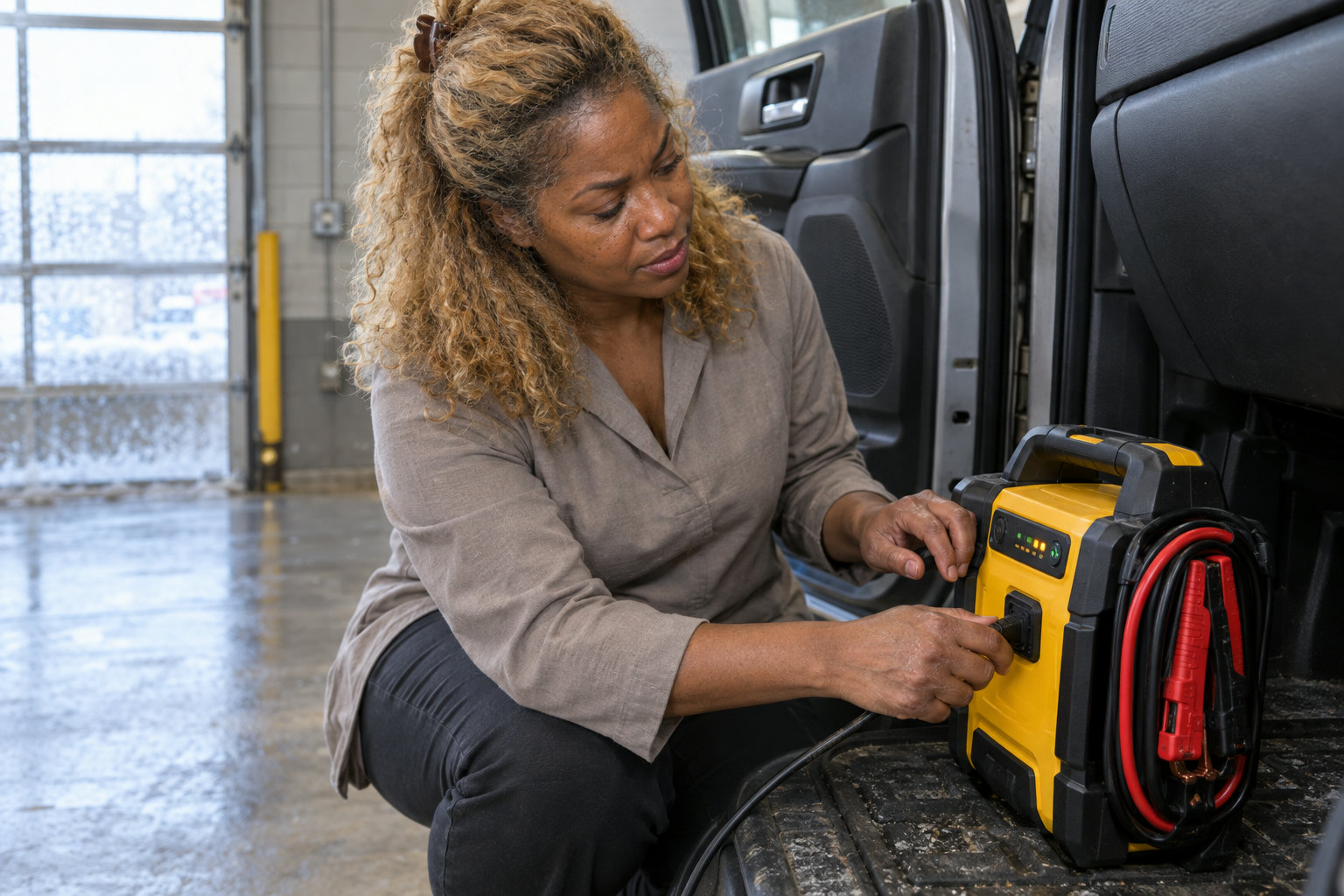
- The DEWALT DXAEJ14-Type3 should go back on AC power after every jump, and a partial top-up between calls is better for the battery than running it to empty.
- One internal battery runs the jump clamps, the 120 PSI digital compressor and the USB ports, so inflating tires or charging a tablet reduces what's left for the next boost.
- Cold batteries accept charge poorly, and most battery makers advise against charging below freezing (0°C / 32°F), so let the unit warm to room temperature indoors first.
- An Alert Stamping 5020TF-4C reel puts four 15A outlets on a 20 ft retractable cord for a tidy charging station; the reel delivers AC power but never charges a battery by itself.
- For diesel trucks and heavy engines, the DEWALT DXAEPS14-Type2 carries a published 2000 peak amp rating, a 500W AC inverter and USB-A/C outputs.
The Short Answer: Yes, Recharge the DEWALT DXAEJ14-Type3 Between Calls in Calgary
The DEWALT DXAEJ14-Type3 is designed to be topped up whenever it's near AC power. So yes, you can recharge the DEWALT DXAEJ14-Type3 between calls, and it's the single best habit for keeping it ready. A partial charge over a lunch break restores usable capacity, and a full charge at the end of the shift sets you up for the next morning.
If you're a mobile detailer, a lot attendant at a busy dealership, or a roadside tech who boosts several cars before noon, two rules matter more than anything else. Charge it warm, not straight out of a frozen truck box. And remember that the 120 PSI compressor and the USB ports drain the same battery you jump with.
Follow those two rules and the unit stays ready through a full day. Ignore them and you get the classic failure: clamps on, a click, and nothing.
The Full Answer
Keeping a DEWALT jump pack charged on a service route comes down to five details: how partial charging works, what else drains the battery, temperature, where you plug in, and how you store the unit between shifts. Each one is covered below so you can drop into whichever applies to your day.
Does a short top-up between calls actually help?
A short top-up helps the DXAEJ14-Type3 in two ways. It puts usable charge back for the next boost, and it keeps the battery from sitting deeply discharged. Rechargeable batteries of every common chemistry generally last longer when they're kept near full instead of being cycled down to empty.
Leaving any jump pack flat is the habit that shortens its life most. Lead-acid types are especially prone to sulfation when they're stored discharged, which permanently reduces capacity. Charging partway is never the problem; staying empty is.
Be realistic about timing, though. A full recharge from a deep drain takes hours, not minutes, on most jump packs of this size, and DEWALT's owner's manual lists the expected charge time and how the battery status indicator reads when the unit is full. A twenty-minute plug-in won't refill an empty pack. It will, however, give you more margin than leaving it in the truck.
Why do the compressor and USB ports count against your next jump?
The DEWALT DXAEJ14-Type3 is a jump starter and a portable power station in one housing. The jump clamps, the 120 PSI digital compressor and the USB power outlets all draw from a single internal battery. Think of it as one tank with three taps.
That matters on a mixed call list. Bringing four low tires up to pressure, then charging a phone and a diagnostic tablet over the afternoon, pulls from the same reserve you're counting on for a cold start. The jump that fails at 4 p.m. often failed because of the tire calls at 10 a.m.
The practical fix is simple. After any compressor-heavy call, make charging the priority before the next boost, and check the battery status readout before you head out rather than when you arrive.
What changes when the unit is cold?
Cold temperatures change how the DXAEJ14-Type3's battery behaves. Winters in Calgary bring long stretches well below freezing, according to Government of Canada historical climate data, and chinook winds can swing temperatures sharply within hours. A jump pack that rode in an unheated truck box all night has less available capacity and accepts charge slowly.
Most battery makers advise against charging below freezing (0°C / 32°F), and lead-acid batteries take charge sluggishly when cold. So the order matters: bring the unit inside, let it reach room temperature, then plug it in. Whatever chemistry your manual lists, a warm shop is the safe charging window.
Watch for condensation too. A frozen unit carried into a warm, humid shop can collect moisture on its case and ports, so give it time to dry before connecting power. The heated cab beats the truck box for storage on any day well below zero.
Where should you plug it in during a shift?
A fixed charging spot makes topping up the DXAEJ14-Type3 automatic instead of optional. The ideal is a dry, ventilated spot near the bay door, so the unit goes on charge the moment you walk back in. If plugging in takes effort, it won't happen on a busy day.
Retractable cord reels from Alert Stamping are a clean way to build that spot. The 5020TF-4C is a retractable reel with four outlets, enough for the jump starter, a flashlight like the BLACK+DECKER SLV2B and a phone at one drop. The single-outlet 5020TFC covers a simpler station, and the 45 ft, 20A 8645TFI reaches across a long bay. The 8150MM and 920LSM add an integrated LED work light.
Be clear about what a reel does. It delivers and retracts AC power; it does not charge or maintain batteries on its own. The jump starter's own charging method, as described in DEWALT's manual, does the charging.
A common mistake is coiling extension cords on the floor instead of using a retractable reel. Floor coils create trip hazards in a busy bay and wear the insulation faster as they get stepped on and dragged. Keep the charging spot out of wash bays and anywhere water collects.
One more caution. Don't clip a bench charger such as the BLACK+DECKER BC25BD onto the jump pack's clamps unless the manual explicitly allows it, and only charge from a vehicle's 12V outlet if the manual lists that option. Use the charging path DEWALT designed for the unit.
How should it be stored between shifts?
The DXAEJ14-Type3 should start every shift full, which means the end-of-day charge is the most important one. Plug it in when you park, confirm the status readout shows full before you lock up, and follow the manual on whether to unplug once charged.
During slow stretches, check the charge at least monthly even if the unit hasn't been used, because batteries self-discharge in storage. Keep the clamps seated on their storage posts so they can't touch each other, and store the unit indoors rather than in a vehicle through the coldest weeks.
| Situation | What to do with the DXAEJ14-Type3 | Why |
|---|---|---|
| Back at the shop with a short gap | Plug in immediately for a partial top-up | Any added charge improves the margin for the next boost |
| Unit is cold from the truck | Warm to room temperature, let it dry, then charge | Charging below 0°C (32°F) is generally discouraged |
| Heavy 120 PSI compressor use | Charge before the next jump call | Compressor and clamps share one battery |
| End of shift | Full charge, confirm the status readout | Every shift should start at full capacity |
| Idle for weeks | Check and top up at least monthly | Stored batteries self-discharge over time |
| No AC access between calls | Follow the manual's approved charging methods only | Improvised charging can damage the unit |
If you want the habit in a form you can tape inside the shop door, here's a simple between-call routine.
Return both clamps to their storage posts as soon as the boosted vehicle is running, so they can't touch in transit.
Keep the unit in the heated cab on cold days so it arrives at the shop ready to charge.
Connect it to the fixed charging spot, such as a reel-fed outlet, the moment you walk in, using the method in DEWALT's manual.
Read the battery status indicator before heading to the next call, not after you arrive.
Give it a complete charge at the end of every shift so tomorrow starts at full capacity.
When the Answer Is Different
Topping up a DEWALT jump starter between jobs covers most working days. Five situations call for a different plan, and recognizing them early saves both the unit and the call.
The pack was drained completely
A fully drained DXAEJ14-Type3 needs a complete charge before you count on it again. A quick top-up after a total drain may not deliver a reliable boost, so give it the full charge time listed in DEWALT's manual. If it repeatedly fails to reach full, the internal battery may be at the end of its service life.
The vehicle is a diesel or a heavy engine
Cold diesel engines demand far more cranking current than a typical gas car. A common mistake is relying on a generic jump pack with no published peak-amp rating for these starts; such units often fail on cold-cranking diesels. If your call list includes pickups and work trucks, the DEWALT DXAEPS14-Type2, with a published 2000 peak amps, a 500W AC inverter, a 120 PSI digital compressor and USB-A/C outputs, is worth a look. ESN's DXAEPS14 vs DXAEJ14 winter roadside comparison walks through where each one fits.
The same car needs a boost every morning
A vehicle that needs a jump every day has a battery or charging-system problem, and no jump pack fixes that. The battery needs a proper charge and a test. The BLACK+DECKER BC25BD is a 25 Amp 12V bench charger, while the DEWALT DXAEC2 (2 Amp) and the DEWALT 12V 4 Amp waterproof charger/maintainer handle slower charging and maintenance. ESN's jump starter vs bench charger breakdown covers when each tool is the right call.
The dead batteries are showroom or lot inventory
For a dealership service manager with a full lot, jumping display vehicles one by one is a symptom, not a routine. Infotainment screens and alarm systems create parasitic drain that keeps pulling batteries down. DEFA Professional Showroom Chargers (30A and 40-50A) and DEFA Professional Workshop Chargers (30-35A, 35A, 50A and 125A) are hard-wired multi-stage automotive chargers built for exactly that environment, so the jump starter can stay reserved for true emergencies.
You have no AC access between calls
A tech who works entirely from a truck may never pass a wall outlet between calls. In that case, only use charging methods the DXAEJ14-Type3 manual approves. Whether a power inverter suits your charger depends on its continuous rating and the charger's draw, so check both before relying on it. Otherwise, plan to start each day full and keep compressor and USB use light.
Our view
In our opinion, buyers overweigh the spec sheet and underweigh the charging habit. A jump starter's rated output only matters if the battery behind it is full and warm when the clamps go on. The best way to keep any DEWALT jump pack performing is boring: recharge the DEWALT DXAEJ14-Type3 between calls, every time, at room temperature.
We'd also argue the charging station deserves as much thought as the jump starter. A dry, reel-fed spot by the door, using an Alert Stamping reel instead of a cord on the floor, turns charging into a reflex. Habits that take no effort survive the busiest days of winter.
Finally, match the tool to the job. The DXAEJ14-Type3 is a capable all-rounder for cars, tires and devices; heavy diesels point toward the DXAEPS14-Type2, and repeat dead batteries point toward a real charger. Using the right one keeps every tool working longer.
Frequently Asked Questions
How long does the DEWALT DXAEJ14-Type3 take to fully recharge?
The DEWALT DXAEJ14-Type3's full recharge time depends on how deeply it was drained and how warm the battery is, and DEWALT's owner's manual lists the expected time for the unit. As a rule, a full recharge from a deep drain takes hours rather than minutes. That's why topping up after each call works better than waiting until it's empty.
Can I leave the DXAEJ14-Type3 plugged in overnight?
Leaving the DXAEJ14-Type3 plugged in overnight is covered by DEWALT's owner's manual, which states how long to charge and when to disconnect. Follow that guidance, confirm the battery status indicator reads full before the shift starts, and check the charge at least monthly when the unit sits idle.
Does using the 120 PSI compressor drain the jump starter battery?
The 120 PSI digital compressor on the DXAEJ14-Type3 runs from the same internal battery as the jump clamps and USB ports. Inflating several tires reduces the charge left for your next boost, so recharge the unit after compressor-heavy calls before heading to a dead battery.
Can a retractable cord reel like the Alert Stamping 8645TFI charge my jump starter?
The Alert Stamping 8645TFI is a retractable extension cord reel: it delivers AC power to wherever you charge the jump starter, but it does not charge or maintain batteries by itself. The DXAEJ14-Type3's own charging method, as described in DEWALT's manual, does the actual charging.
Have a Similar Question?
Whether you run boost calls in Calgary or anywhere else in Canada, ESN Tools can help you pick between the DXAEJ14-Type3 and the DXAEPS14-Type2, size a reel for your charging station, or choose a DEFA charger for lot inventory. Send your question through the ESN Tools contact page, and ask there for current pricing and availability.
Sources
- DXAEJ14 product details, including the 120 PSI digital compressor and USB power: ESN Tools, DEWALT DXAEJ14 Jump Starter product page
- Manufacturer owner's manuals, charging instructions and support: DEWALT official site
- Historical winter temperature records for Canadian cities: Government of Canada, Historical Climate Data
- Workplace electrical safety and trip hazards from cords: Canadian Centre for Occupational Health and Safety
 Listen to this articleAudio version
- A Montreal Dealership Parts Manager Asked: "Can the DEWALT DXAEJ14-Type3 Jump Starter's USB Output Charge Diagnostic Tablets Between Calls?", Here's What to Know
- DEWALT DXAEJ14-Type3 vs BLACK+DECKER BC25BD: Portable Jump Starter vs Bench Charger for a Canadian Mobile Mechanic
- DEWALT DXAEPS14-Type2 vs DEWALT DXAEJ14-Type3: Which Jump Starter Power Station Suits a Canadian Winter Roadside Call
- DEWALT Automotive Inflator Pressure Consistency Tested Across 211 Service Calls — The Variance That Affects Tire Safety
- DXAEJ14-Type3 1400A Jump Starter With AC Outlets: Mobile Tech Buyer Guide