

Last updated: October 9, 2026
Published October 9, 2026 · Updated October 9, 2026
Alert Stamping 920LSM LED cord reel lumens for paint match colour inspection: Edmonton collision shop estimators should treat the 920LSM as a task and defect-finding light, not as the final color-match standard. Paint matching depends on color temperature and color rendering (CRI) far more than on raw lumen output. Edmonton adds its own twist: at about 53.5°N, the city gets only about seven and a half hours of daylight near the December solstice, so most winter color decisions happen under artificial light.
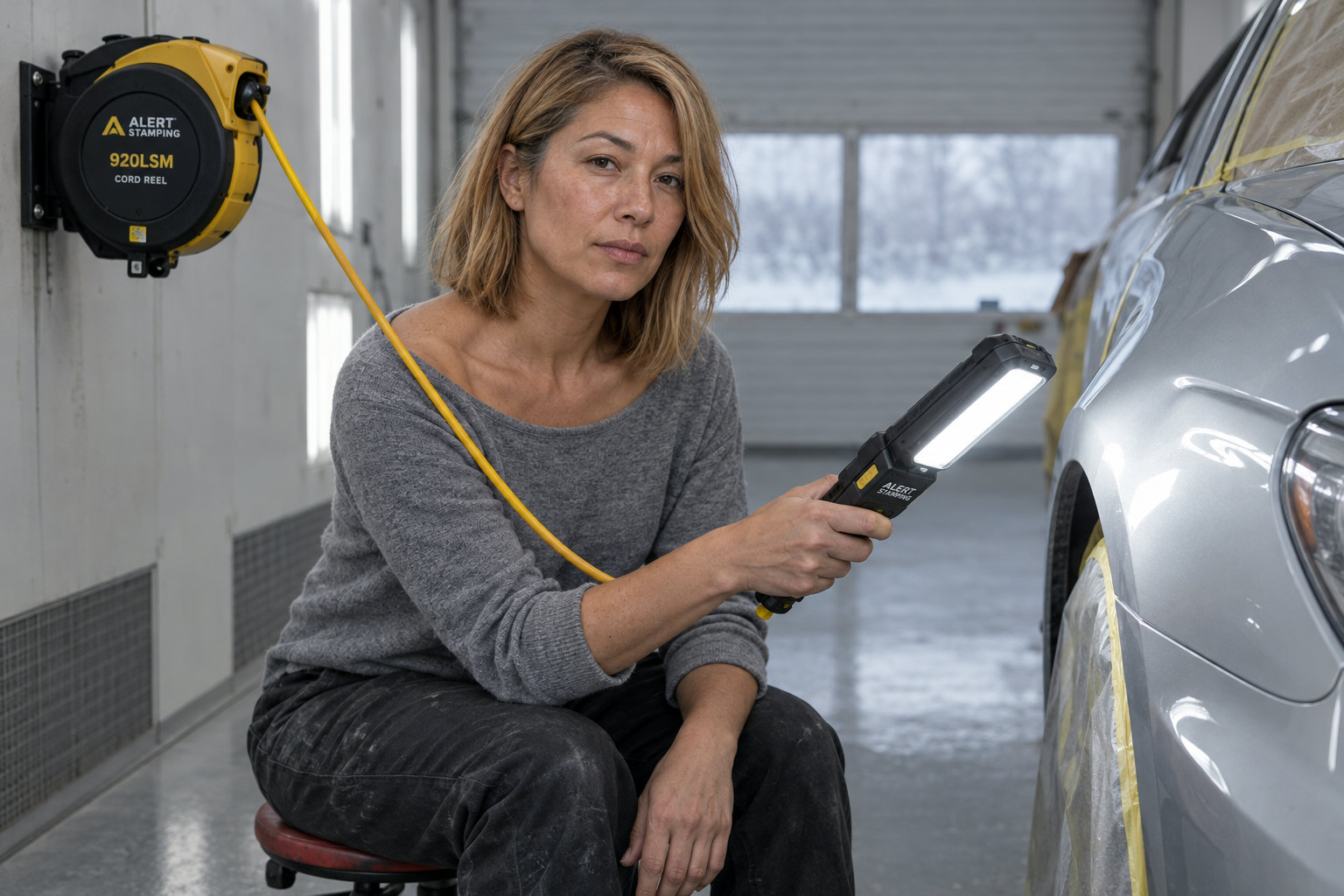
- The Alert Stamping 920LSM is a retractable extension cord reel with an integrated LED work light. It is built for task lighting and defect spotting, not for certified color evaluation.
- Lumens measure a light's total output. Paint-match decisions depend on color temperature (daylight is roughly 5000K - 6500K) and color rendering (CRI 90 or higher is the usual target).
- Edmonton gets about seven and a half hours of daylight near the December solstice, so a winter afternoon color check usually happens after sunset.
- The Alert 8150MM reel pairs a 14W LED shop light rated at 1,500 lumens with a 50-foot 14/3 SJTOW cord, which makes it the brighter general bay light of the two LED reels ESN Tools carries.
- The BLACK+DECKER SLV2B is a rechargeable 750-lumen LED flashlight. It works as a cordless second light for checking a repair from another angle.
- Moving a small light from 30 cm to 60 cm away from a panel cuts the light landing on that surface to roughly a quarter. This is the inverse-square law, and it matters more than the lumen number on the box.
- Latitude about 53.5°N. Near the December solstice, Edmonton sees sunrise close to 8:50 a.m. and sunset around 4:15 p.m. Near the June solstice, daylight runs about 17 hours (NRC sunrise/sunset calculator).
- Cold continental climate. Environment Canada's 1981-2010 climate normals put Edmonton's January daily average well below freezing. Vehicles often arrive at the shop cold-soaked.
- Dry winter air. Low indoor humidity in heated bays encourages static, which pulls dust onto freshly prepped panels.
- Gravel and de-icer on winter roads. Stone chips, road film and salt residue are routine on vehicles coming in for collision and refinish work between November and April.
- Snow glare and a low winter sun. Daylight that does reach the lot in winter arrives at a low angle and bounces off snow, so "just roll it outside" is not a neutral color check.
Alert Stamping 920LSM LED Cord Reel Lumens for Paint-Match Colour Inspection in an Edmonton Collision Shop: The Short Answer
The Alert Stamping 920LSM is a retractable extension cord reel with an integrated LED work light. That makes it two tools in one: a source of AC power that retracts off the floor, and a portable task light you can pull to the panel. Neither of those jobs is "color-matching standard."
If you're an estimator or refinish tech in an Edmonton collision shop, writing up a blend at 4:30 p.m. in December after the sun has already set, here is the honest answer. The 920LSM is a good light for finding dents, sanding scratches, dirt nibs and orange peel. It is not the light that should decide whether a mixed basecoat matches the adjacent panel.
The reason is physics, not brightness. Lumens describe how much visible light a source emits in total. Color judgment depends on the spectrum of that light, which is summarized by two published numbers: correlated color temperature (in kelvin) and color rendering index (CRI).
Why more lumens does not mean a better match
A very bright LED with a weak red spectrum will make a candy red look flat and a warm silver look cool. Two paints with different pigment recipes can look identical under one light and different under another. The refinish trade calls this metamerism, and adding lumens does not fix it.
The usual guidance for visual color evaluation is a daylight-balanced source, roughly 5000K to 6500K, with a CRI of 90 or higher. Check the result under more than one light source as well. If a work light's published spec does not list a color temperature and CRI in that range, treat it as an inspection light. Confirm the 920LSM's current lumen, color temperature and cord specifications on the Alert Stamping listing, or ask ESN Tools, before you assign it a role in the paint department.
Why Edmonton Is Different
Edmonton collision shops do paint-match work under tighter lighting constraints than shops in southern Ontario or coastal British Columbia. At about 53.5°N, Edmonton is one of the northernmost large cities in North America. The winter daylight window is short and arrives at a low angle.
Short days change the workflow. A shop in Mississauga or Vancouver can often wheel a car out for a daylight check in mid-afternoon. In Edmonton during December, sunset lands around 4:15 p.m., and the light before that is low, warm-tinted and bounced off snow. Artificial lighting is not a backup for half the year. It is the primary color environment.
Cold vehicles and condensation
Vehicles towed into an Edmonton bay in January are often cold-soaked. A cold panel pulled into a heated shop will fog or bead with condensation. That film scatters light and changes how gloss and color read. Any inspection light, including the 920LSM, will show a misleading surface until the panel reaches shop temperature and is fully dry.
Dry air, static and dust
Heated Edmonton bays in winter tend to run dry. Dry air builds static on plastic bumper covers and prepped panels, and static attracts dust. This is where a portable LED task light earns its keep. Held at a low, raking angle, it shows dust and lint that overhead fixtures miss.
Gravel season damage
Winter roads around Edmonton are treated with gravel and de-icing material. Hoods, front bumpers and rocker panels collect stone chips and road film. Small chip repairs and spot blends are exactly the jobs where a close-up task light matters most, and where a mismatched blend shows up most clearly once the customer parks in spring sunshine.
Common Problems in Edmonton Collision Shops
Edmonton collision shops tend to share a predictable set of lighting and power problems in the paint and prep areas. None of them is solved by buying the brightest light available. Each one has a specific cause.
1. Judging color under a single light source
Approving a blend under only the bay ceiling fixtures, or only a handheld LED, is a common way to miss metamerism. The repair looks right in the shop and wrong in the parking lot. The fix is procedural: compare a spray-out card under a daylight-balanced, high-CRI source, then confirm under a second, different source.
2. Measuring lumens when the panel needs lux
Lumens are emitted at the light. Lux is what actually lands on the panel, and it falls quickly with distance. For a small source, doubling the distance cuts illuminance to roughly a quarter. A light held too close also creates a hot spot on clearcoat that washes out color and flake.
Metallics and pearls make this worse. They need to be viewed at the face angle and at a steep side angle (the "flop"), and one handheld light at one distance cannot show both.
3. Cords coiled on the floor of the prep area
A common mistake is coiling extension cords on the floor instead of mounting retractable cord reels. Floor cords create trip hazards around a car that people are walking around with sanders and spray guns. Cords that get stepped on, rolled over and dragged also wear their insulation faster. In a cold Edmonton bay near an overhead door, a stiff cord jacket that keeps getting kinked is a cord that cracks early.
4. Non-rated lighting in wash and detail bays
Many Edmonton collision shops also wash and detail vehicles before delivery. Skipping IP-rated job-site lighting in wash bays is a mistake that tends to end with fixtures failing within months. Check the ingress protection rating of any light, reel-mounted or not, before it goes near a pressure washer or slush melting off a vehicle.
How We Approach This Area
ESN Tools approaches Edmonton collision shop lighting by splitting it into three separate jobs: bay power, inspection light and color-evaluation light. The Alert Stamping 920LSM covers the first two jobs well. The third job needs a light with a published color temperature and CRI suited to color work.
This matters most for collision shop managers in Edmonton who are outfitting a new prep station or replacing worn cords before winter. It matters less for a mobile detailer who only needs a light for interiors.
Matching each light to the task
| Light | Published output | Where it wins in an Edmonton shop | Final paint-match light? |
|---|---|---|---|
| Alert Stamping 920LSM (cord reel with LED light) | Confirm on the current listing | Close-up defect finding, prep checks, under-hood light plus AC power off the floor | No, use it for inspection |
| Alert 8150MM (cord reel with LED shop light) | 14W LED, 1,500 lumens, 50 ft 14/3 SJTOW cord | Brighter general light across a full panel or bay, with longer reach | No, unless its spec meets your CRI and kelvin target |
| BLACK+DECKER SLV2B (rechargeable flashlight) | 750 lumens | Cordless second light, raking-angle checks, door jambs and lot walk-arounds | No, use it as a secondary check |
| Daylight-balanced color-evaluation lamp | Roughly 5000K - 6500K, CRI 90+ | Spray-out card comparison and blend approval after dark | Yes, this is its job |
For a direct side-by-side of the two LED reels, see the Alert Stamping 8150MM vs 920LSM collision shop comparison. Full specifications are on the Alert ProReel 8150MM product page, including the grounded outlet and on/off handle switch.
A paint-match workflow built for Edmonton winters
Let a cold-soaked vehicle reach shop temperature so condensation clears. Color and gloss read falsely through a damp film.
Pull the reel's LED light to the panel and hold it at a low, raking angle to find dents, sand scratches and dust before any color goes on.
Apply the mixed color and clear to a spray-out card using the same gun setup and coats planned for the vehicle.
Hold the card against the adjacent panel at the face angle and a steep side angle, under a 5000K - 6500K, CRI 90+ light.
Recheck under different light, such as booth lighting, midday daylight when available, or the BLACK+DECKER SLV2B, to catch metamerism.
Recording which lights were used for approval makes it easier to explain a decision if a customer questions the match in spring sunlight.
Power and batteries are separate jobs
The Alert Stamping 920LSM delivers AC power and light. It does not charge or maintain a vehicle battery. That distinction matters in Edmonton, where a vehicle waiting weeks for parts in a cold lot can come back with a flat battery.
The battery side is handled by dedicated equipment. ESN Tools carries DEFA Professional Workshop Chargers (30-35A, 35A, 50A and 125A), the DEWALT DXAEC2 2 Amp charger, the DEWALT 12V 4 Amp waterproof charger/maintainer and the BLACK+DECKER BC25BD 25 Amp bench charger. For a cold start, the DEWALT DXAEPS14-Type2 jump starter is rated at 2000 peak amps and adds a 500W AC inverter and a 120 PSI digital compressor.
Shops weighing how LED reels behave outside the heated bay in a Prairie winter can also read the Winnipeg detailer's 920LSM outdoor winter question. Winnipeg's cold is close enough to Edmonton's for the same cautions to apply.
Our view
In our opinion, buyers overweight lumens when choosing shop lighting. A lumen number is easy to compare on a box, so it becomes the deciding factor, even for color work where it is close to the least important spec. For paint matching in an Edmonton collision shop, color temperature, CRI and viewing angle decide the outcome.
We think the Alert Stamping 920LSM is worth its place in a body shop for what it actually does well. It gets the cord off the floor, puts a light where the tech's eyes are, and makes prep defects visible before they become a redo. Asking it to also be the color-approval standard sets it up to fail at a job it was not designed for.
The single most useful change most shops can make costs nothing: check every blend under two different light sources before releasing the car. In a city with about seven and a half hours of December daylight, that habit does more for paint-match accuracy than any brighter bulb.
FAQ
Is the Alert Stamping 920LSM bright enough for paint-match color inspection in an Edmonton collision shop?
The Alert Stamping 920LSM gives Edmonton collision shops enough light for defect finding and prep inspection, but brightness is not what qualifies a paint-match light. Final color approval should happen under a daylight-balanced source of roughly 5000K - 6500K with a CRI of 90 or higher. Confirm the 920LSM's current lumen and color specs with ESN Tools before deciding its role.
What light should an Edmonton body shop use for color matching in winter?
Edmonton body shops color matching in winter need a daylight-balanced, high-CRI lamp, because December sunset falls around 4:15 p.m. and natural light is scarce. Compare a spray-out card at face and side angles, then recheck under a second source such as booth lighting or a BLACK+DECKER SLV2B flashlight to catch metamerism.
How does the 920LSM compare with the Alert 8150MM for an Edmonton paint and prep area?
The Alert 920LSM and Alert 8150MM are both retractable cord reels with LED lights, and both suit inspection rather than final color approval. The 8150MM's published spec is a 14W LED shop light rated at 1,500 lumens on a 50-foot 14/3 SJTOW cord, which makes it the stronger choice for lighting a full panel. Ask ESN Tools which reel fits your bay layout and reach.
Can the Alert 920LSM cord reel charge a vehicle battery in a cold Edmonton lot?
The Alert 920LSM cord reel cannot charge or maintain a vehicle battery. It delivers AC power and LED light only. For batteries in cold Edmonton lots, ESN Tools carries DEFA Professional Workshop Chargers, the DEWALT DXAEC2 and DEWALT 12V 4 Amp maintainer, and the DEWALT DXAEPS14-Type2 jump starter rated at 2000 peak amps.
Sources
- Edmonton sunrise, sunset and daylight length by date: National Research Council Canada, Sunrise/sunset calculator
- Edmonton winter temperature normals: Environment and Climate Change Canada, Canadian Climate Normals
- Alert 8150MM specifications (14W LED, 1,500 lumens, 50 ft 14/3 SJTOW): ESN Tools, Alert ProReel 8150MM product page
- Manufacturer information for Alert Stamping cord reels: Alert Stamping & Mfg. Co.
Have a question about lighting or power for an Edmonton prep station? Contact ESN Tools for current 920LSM specifications and availability.
 Listen to this articleAudio version
- A Winnipeg Auto Detailer Asked: "Is the Alert Stamping 920LSM Cord Reel With LED Light Rated for Outdoor Use i
- How a Hamilton Body Shop Used the Alert Stamping 8150MM Cord Reel With LED Light to Reduce Inspection Errors U
- Alert Stamping 8150MM vs Alert Stamping 920LSM: Which Retractable Cord Reel With LED Work Light Fits a Canadia
- A Calgary Dealership Detailer Asked: When Should I Use the BLACK+DECKER SLV2B Flashlight Instead of the Alert
- A Brampton Fleet Manager Asked: "Can the Alert Stamping 8645TFI 45ft Cord Reel Handle a 20A Circuit in an Unhe