

Last updated: November 10, 2026
Published November 10, 2026 · Updated November 10, 2026
 Listen to this articleAudio version
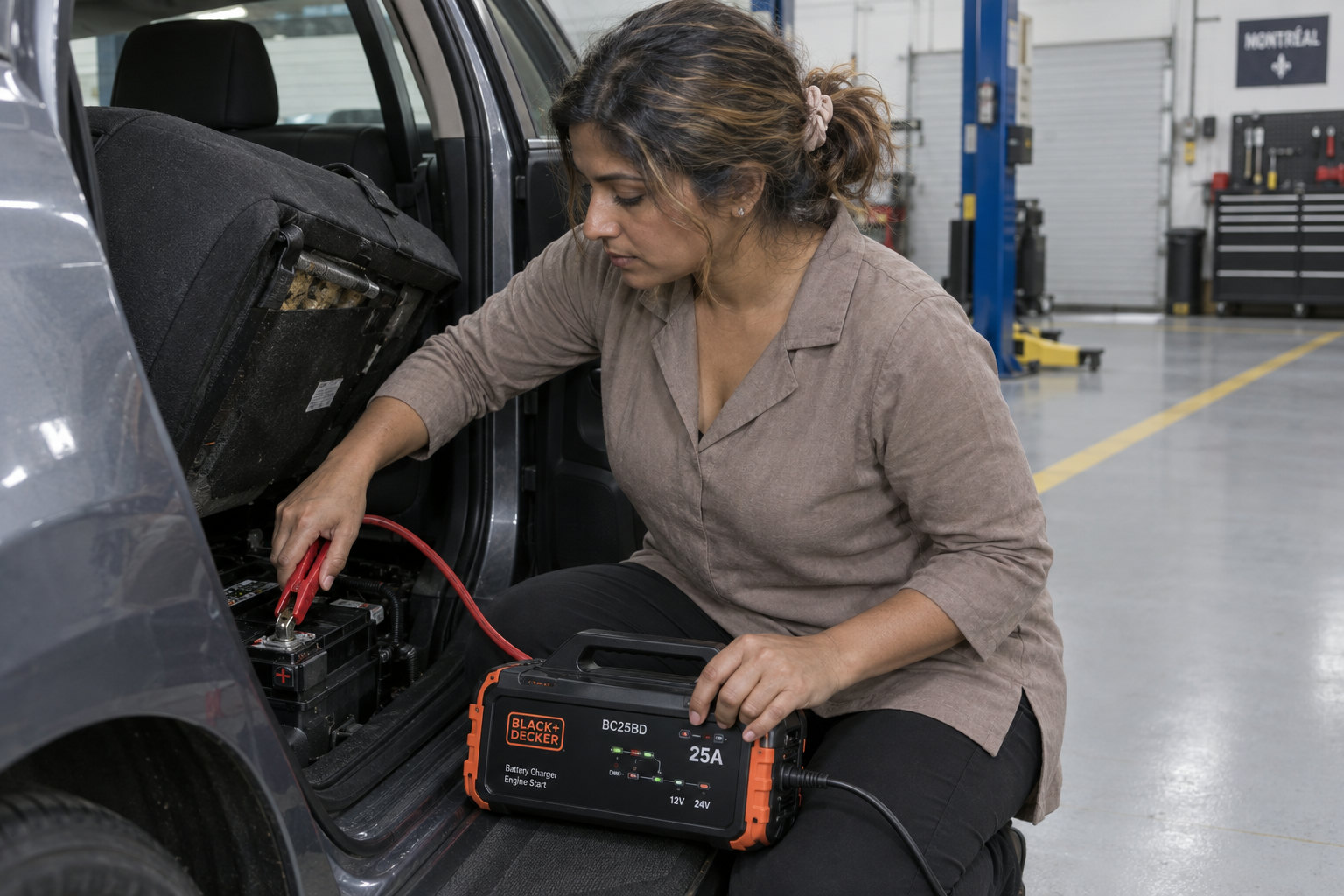
For bench charging vs in-vehicle charging for Montreal shops, battery removal labor is the deciding factor. The BLACK+DECKER BC25BD 25 Amp 12V bench charger wins when the battery lifts out easily or needs a close inspection. In-vehicle charging wins when getting the battery out means pulling seats, trunk trim or wheel-well liners. Neither method puts amps into a battery faster; the difference is the technician time spent before and after the charger is connected.
If you're a service manager or independent shop owner dealing with under-hood, trunk-mounted and under-seat batteries through a long winter, the right answer changes from car to car. This breakdown is for shops that charge customer and inventory batteries every week. It is not written for a driver topping up one car in a home garage.
- The BLACK+DECKER BC25BD is a 25 Amp, 12V bench charger, and it suits batteries that are already out of the vehicle or easy to reach with its cable clamps.
- Battery removal labor covers disconnecting, releasing the hold-down, lifting out, reinstalling and resetting learned settings, and a higher-amp charger shortens none of those steps.
- In-vehicle charging keeps radio presets, window auto-up calibration and battery-sensor values intact because the 12V supply is never cut.
- Parasitic drain from infotainment, alarm and telematics modules keeps running during in-vehicle charging, so the charger must cover the drain and the recharge; DEFA Professional Workshop Chargers come in sizes from 30A to 125A.
- A frozen battery should never be charged, and bench charging lets a cold battery warm up indoors before the BC25BD is connected.
- The DEWALT DXAEC2 (2 Amp) and the DEWALT 12V 4 Amp waterproof charger/maintainer are built for holding a charge in place, not for fast recovery of a flat battery.
- Where the labor hides
- Bench charging with the BLACK+DECKER BC25BD
- In-vehicle charging: leaving the battery in place
- The removal steps a shop pays for
- Winter cold and road salt
- EVs, public charging and the 12V battery
- Power and layout for a charging station
- When to choose which
- Our verdict
- Our view
- FAQ
- Sources
Bench Charging vs In-Vehicle Charging for Montreal Shops: Where the Labor Hides
Battery removal labor is the time a technician spends getting a 12V battery out of a vehicle and back in. It is the single biggest difference between bench charging and in-vehicle charging. The charger itself, whether a BLACK+DECKER BC25BD on the bench or a DEFA unit wired into a bay, does the same chemical job either way.
Battery location drives that labor. An under-hood battery with a simple hold-down clamp comes out quickly. Many current models place the battery in the trunk, under a rear seat, beneath the front passenger floor or behind a wheel-well liner, and those vehicles usually provide remote positive and ground posts under the hood for jumping and charging.
Those remote posts are a hint from the manufacturer. If the engineers built a way to charge the battery without reaching it, pulling it out is extra work the job may not need. The table below compares the two approaches on the factors that change a shop's day.
| Factor | Bench charging (BC25BD on the bench) | In-vehicle charging (battery stays installed) |
|---|---|---|
| Removal labor | Access, disconnect, release hold-down, lift out, carry, reinstall, reset | None; clamps go on the terminals or remote posts |
| Learned settings | Radio presets, clock, window auto-up limits and sensor values may reset | Kept, because 12V power is never cut |
| Vehicle loads during charge | None; the charger sees only the battery | Parasitic drain from modules, alarm and telematics continues |
| Inspection access | Full view of case, base, terminals and tray | Top and terminals only |
| Vehicle tie-up | Vehicle and charger are decoupled | Vehicle stays tethered to a charger and power cord |
| Cold-weather handling | Battery can warm indoors before charging | Battery warms only as fast as the whole vehicle |
| Best-fit ESN gear | BLACK+DECKER BC25BD (25 Amp, 12V) | DEFA Workshop/Showroom Chargers (30A to 125A), DEWALT 12V 4 Amp, DEWALT DXAEC2 (2 Amp) |
Notice what is missing from that table: charge speed. A 25 Amp charger is a 25 Amp charger whether the battery sits on a bench or in an engine bay. The cost of each method lives in the labor rows.
Bench Charging With the BLACK+DECKER BC25BD
Bench charging with the BLACK+DECKER BC25BD means the 12V battery comes out of the vehicle and sits on a dedicated charging surface. ESN Tools lists the BC25BD as a fully automatic 25 Amp 12V bench charger and maintainer with a 75A engine-start function, an alternator check and cable clamps.
The biggest strength is isolation. With the battery off the vehicle, the charger is not fighting module wake-ups, door-ajar lights or a telematics unit checking in. The technician also sees the whole battery: a bulged case, a cracked base, a crusted tray or a corroded hold-down that would stay hidden in the car.
Bench charging also frees the vehicle. Work that does not need 12V power can continue while the battery charges across the room. For a battery headed for replacement anyway, it already has to come out, so bench charging adds no new labor.
Where bench charging falls short
The weakness is everything around the charge. Removal can mean seat bolts, trunk floor panels or liner fasteners, and every disconnect risks resetting learned values. Lead-acid batteries are heavy and hold acid, so carrying them adds handling risk.
Bench space matters too. Charging flooded batteries releases hydrogen, so the bench needs ventilation and no nearby sparks or open flames. For French-speaking technicians, ESN also publishes the BC25BD product page in French.
In-Vehicle Charging: Leaving the Battery in Place
In-vehicle charging connects the charger to a 12V battery that stays installed, either at the terminals or at the remote charging posts. It removes battery removal labor entirely. It also keeps every module powered, so presets, window calibrations and battery-sensor data survive the job.
ESN carries several in-vehicle options. DEFA Professional Workshop Chargers (30-35A, 35A, 50A and 125A) and DEFA Professional Showroom Chargers (30A and 40-50A) are hard-wired, multi-stage units built for service bays and display floors. The DEWALT 12V 4 Amp waterproof charger/maintainer suits holding a charge on a single vehicle, and a clamp-type charger like the BC25BD can also connect to an installed battery when its manual's connection steps are followed.
The trade-off is parasitic drain. Infotainment, alarm and telematics modules keep drawing current, so the charger must supply that load before any amps reach the battery. A common mistake is using a consumer trickle charger to maintain showroom-display batteries; it lacks the amperage to overcome that drain, and the battery slowly loses ground while looking "plugged in."
In-vehicle charging also hides the battery's base and sides. A cracked case or a seized, rusted hold-down stays out of sight. And the vehicle stays tethered to a charger and cord until the job is done.
The Battery Removal Steps a Shop Actually Pays For
Battery removal labor is easy to underestimate because each step looks small. Listing them out makes the comparison between bench charging and in-vehicle charging much clearer. Here is what a typical battery-out job involves before the BC25BD is even switched on.
Open the hood, or remove the trunk floor, rear seat cushion or wheel-well liner on vehicles with relocated batteries.
Note radio codes and presets, or decide whether to use a memory-saver supply so modules keep power.
Removing the ground cable first keeps a wrench from shorting the positive terminal to the body.
Salt-corroded hold-down hardware can seize, and the battery must be lifted level to avoid acid spills.
Connect the BC25BD clamps before plugging it in, charge in a ventilated spot, and inspect the case and tray meanwhile.
Reconnect positive first and negative last, secure the hold-down, then run any window, idle or sensor relearn the vehicle requires.
Winter Cold and Road Salt Change the Comparison
Montreal winters bring long stretches below freezing, and that shifts the bench-versus-in-vehicle math. A discharged lead-acid battery freezes at a much higher temperature than a fully charged one, because its electrolyte is closer to plain water. A battery that may be frozen should never be charged until it has thawed.
Bench charging handles that well. The battery comes into a heated room, warms on its own, and gets a visual check for a bulged or cracked case before the BC25BD goes on. In-vehicle charging relies on the whole car warming up in the bay, which is slower for a battery tucked under a rear seat or trunk floor.
Road salt cuts the other way. Corroded terminals and rusted hold-down hardware make removal slower. They also make bench time more valuable, since cleaning a tray and terminals is far easier with the battery out.
Cold also affects the jump-start decision before charging even begins. A dead car in the lot may need the DEWALT DXAEPS14-Type2 (2000 peak amps, 500W AC inverter, 120 PSI digital compressor) just to reach a bay. A jump starter moves the car; it does not replace a full recharge from a proper charger.
Electric Vehicles, Public Charging and the 12V Battery
Electric vehicle charging, the public stations, fast-charger billing and provincial EV strategy that dominate local search results, concerns the high-voltage traction battery. Shop battery charging concerns the 12V system. The two topics share a word and little else.
Most EVs and hybrids still carry a conventional 12V auxiliary battery that powers locks, screens and the systems that wake the car. When that 12V battery goes flat, many EVs cannot wake up to engage the traction pack, so the large battery cannot rescue the small one. The shop has to recharge the 12V directly.
On EVs, the case for in-vehicle charging is usually stronger. Auxiliary batteries can sit in tight locations, and many models provide dedicated 12V access points for charging and jumping. The "fast versus standard" debate also translates: a 25 Amp BC25BD shortens charge time compared with a 4 Amp maintainer, but no charger rating shortens the time it takes to reach a buried battery.
Power and Layout for a Charging Station
A bench charging station needs AC power where the BC25BD sits, and an in-vehicle setup needs power reaching every bay. Alert Stamping retractable extension cord reels deliver that AC power; they do not charge or maintain batteries themselves. The 5020TF-4C (20ft, 15A, 4 outlets) suits a bench with a charger, a light and a tester sharing one drop.
For in-vehicle charging in a far bay, the 8645TFI (45ft, 20A, single outlet) reaches farther. The 8150MM and 920LSM reels add an integrated LED work light, which helps when the battery lives under a seat or floor panel. The BLACK+DECKER SLV2B flashlight covers spots a mounted light cannot reach.
A common mistake is coiling extension cords on the floor instead of using retractable reels. Loose coils create trip hazards around a technician carrying a battery and wear insulation faster. Charger placement also changes with lift work; ESN covers that in its guide to lift-bay vs ground-bay battery charging.
Ventilation is not optional. Charging flooded batteries releases hydrogen, and Canadian occupational safety guidance calls for good airflow and no ignition sources near charging areas. In Quebec, workplace safety falls under the CNESST.
- Choose bench charging with the BC25BD when the battery is under the hood with a simple hold-down, when it is coming out for testing or replacement anyway, when it may be frozen, or when salt corrosion means the tray and terminals need cleaning.
- Choose in-vehicle charging when the battery sits under a seat, under the trunk floor or behind a liner, when the vehicle has remote charging posts, or when a disconnect would trigger relearn procedures.
- Choose hard-wired in-vehicle charging (DEFA) for showroom and inventory vehicles that must stay charged against parasitic drain day after day.
- Choose a DEWALT 12V 4 Amp or DXAEC2 (2 Amp) maintainer for holding a healthy battery on a single parked vehicle, not for recovering a flat one.
Our Verdict
For bench charging vs in-vehicle charging for shops, neither method wins outright. The winner is decided vehicle by vehicle, and the deciding question is how long the battery takes to reach.
The independent general repair shop gets the most from a BC25BD bench station as the default for under-hood batteries and any battery being tested or replaced. Relocated batteries should be charged in place through the remote posts.
The dealership service manager with a full lot needs both. DEFA hard-wired chargers keep showroom and inventory vehicles topped up in place, while a BC25BD bench handles batteries that come out for service. One method does not replace the other.
The auto detailer rarely needs to pull a battery at all. A DEWALT 12V 4 Amp waterproof maintainer keeps a vehicle's charge steady during a long interior job, with no removal labor and no lost settings.
Our view
This is opinion, plainly labeled. Shops comparing charging methods tend to overweight charger amperage and underweight access time. A 25 Amp BC25BD and a 4 Amp DEWALT maintainer differ a lot in recharge speed, but neither number says anything about a battery buried under a rear seat.
The better habit is to sort vehicles by battery location before choosing a charger. Under-hood batteries go to the bench when there is a reason to inspect them. Relocated batteries get charged in place unless they are coming out anyway.
That approach turns the bench-or-in-vehicle question into a quick routing decision at write-up. For pricing on any of the chargers named here, contact ESN Tools directly.
- BLACK+DECKER BC25BD vs DEFA Professional 35A Workshop Charger: Which 12V Bench Charger Makes Sense for a GTA Service Shop
- DEWALT DXAEPS14-Type2 vs BLACK+DECKER BC25BD: Jump Starter Power Station vs Bench Charger for a Canadian Auto Shop
- What a Typical BLACK+DECKER BC25BD 25A Bench Charger Setup Looks Like Inside a Busy Hamilton Independent Service Shop
- DEWALT DXAEJ14-Type3 vs BLACK+DECKER BC25BD: Portable Jump Starter vs Bench Charger for a Canadian Mobile Mechanic
- A Vancouver Service Tech Asked: Can a BLACK+DECKER SLV2B Inspection Tell an Active Fluid Leak From Old Residue Before Vehicle Pickup?
FAQ
Can the BLACK+DECKER BC25BD charge a battery that is still in the vehicle?
The BLACK+DECKER BC25BD is sold as a 25 Amp 12V bench charger, but its cable clamps can connect to an installed battery, as with most clamp-type chargers. Follow the connection order in the BC25BD manual and use the vehicle's remote charging posts where they exist.
Does removing a battery reset a car's settings?
Removing a 12V battery cuts power to every module, so radio presets, the clock, window auto-up limits and learned idle or battery-sensor values can reset on many late-model vehicles. Some vehicles then need a relearn procedure, which adds time that in-vehicle charging avoids.
What size charger is needed to charge a battery in the vehicle?
In-vehicle charger size depends on the parasitic drain the car's modules draw while the charger works. A DEWALT DXAEC2 (2 Amp) or DEWALT 12V 4 Amp maintainer holds a healthy battery, while recovering a flat one calls for more output, such as the BC25BD's 25 Amps or a DEFA workshop charger rated from 30A to 125A.
Is bench charging safer than in-vehicle charging?
Bench charging and in-vehicle charging both release hydrogen from flooded 12V lead-acid batteries, so both need ventilation and no sparks nearby. Bench charging keeps vehicle electronics out of the circuit but adds lifting and acid-spill risk, while in-vehicle charging avoids handling but keeps modules connected.
Sources
- BC25BD rating (25 Amp, 12V) and listed features (75A engine start, alternator check, cable clamps): ESN Tools BC25BD product page
- Battery charging hazards, hydrogen gas and ventilation: Canadian Centre for Occupational Health and Safety
- Winter temperature data for Canadian cities: Environment and Climate Change Canada, Climate Normals
- Quebec workplace health and safety authority: CNESST